

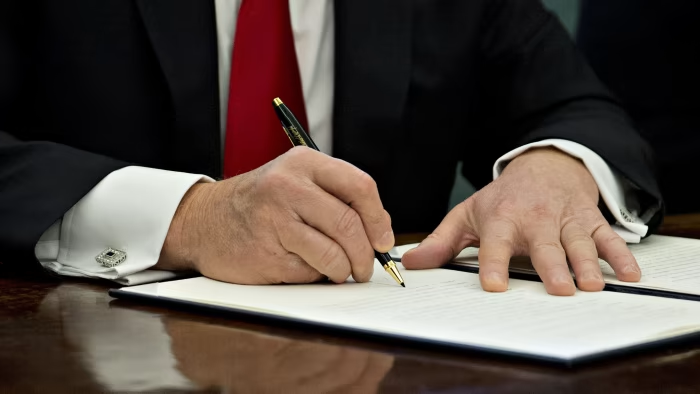
If President Trump signing a new college sports-themed executive order is confusing to you because you thought college sports were saved last August, you are not alone. That was when I wrote about President Trump’s first executive order on college athletics that was intended to save college sports, where I broke down what the order actually did and, just as importantly, what it didn’t do. The short version of that article is that executive orders direct federal agencies. They don’t create new law, and they can’t override existing statutes. That’s exactly why we are here nine months later, and the analysis hasn’t changed. What has changed is that the administration is back, this time with the word “Urgent” in the title.
Flash forward to the present. On April 3, 2026, Trump signed ‘Urgent National Action to Save College Sports,’ that directs federal agencies to implement regulatory measures by August 1, 2026. This order appears much more aggressive than its predecessor as it moves from broad policy guidance toward an enforcement framework with real teeth. For instance, institutions that don’t comply with the order’s requirements risk losing federal funding, with the College Sports Commission making an appearance as the key player in implementation and enforcement.
The substantive provisions are straightforward enough. Eligibility capped at five years. One transfer with immediate eligibility. NIL compensation is limited to fair market value, with collectives squarely in the crosshairs. And of course, the financial backdrop makes the urgency at least understandable. Major programs are hemorrhaging money, and the current model is plainly unsustainable for most athletic departments outside the SEC and Big Ten.
With all that said, I keep coming back to the same problem I raised last August. This is still an executive order. It doesn’t amend NCAA rules, it doesn’t displace existing court decisions, and it doesn’t resolve the antitrust questions that have driven most of this litigation in the first place. Courts have already pushed back hard on eligibility restrictions, and there’s no reason to think that dynamic changes here. Real reform still runs through Congress, which means sixty Senate votes and bipartisan cooperation that neither the SCORE Act nor the SAFE Act has managed to attract.
So is this order meaningful? Maybe. At the very least, I expect it to be more meaningful than the last one. But is it the fix college athletics actually needs? Not even close. Watch for the August 1 deadline, the litigation, and whether Congress treats this as cover to do nothing or a reason to finally move. The effectiveness of this order relies heavily on how these players interact with it.